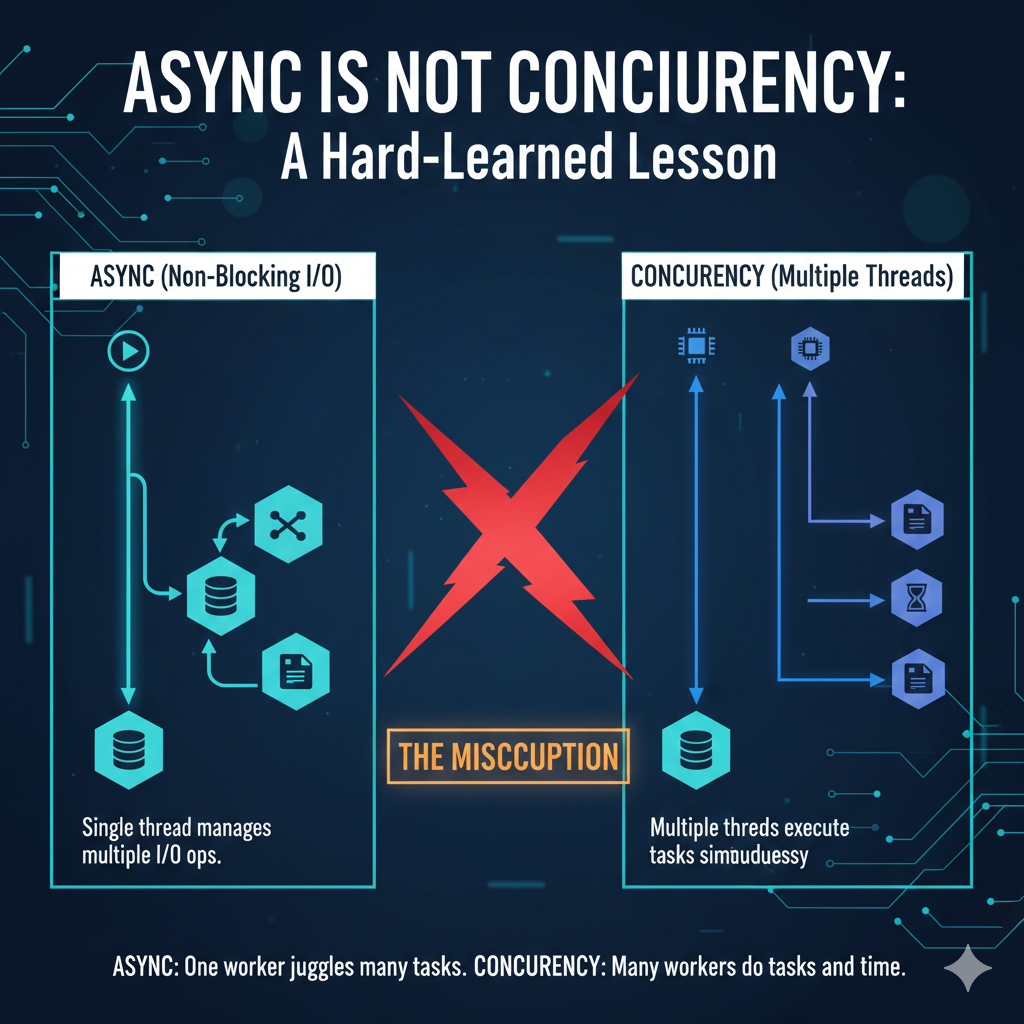
Async Is Not Concurrency: A Hard‑Learned Lesson
Async Is Not Concurrency: A Hard-Learned Lesson
Short description
Async code helps systems avoid blocking while they wait. Concurrency determines how much work a system can actually perform at the same time.
Confusing the two often works fine in development—but production traffic has a way of exposing the difference very quickly.
The Assumption That Caused Trouble
Early in my backend career, I assumed that using async/await automatically meant my system was concurrent.
Requests were non-blocking. Response times looked healthy. Load tests passed.
It felt reasonable to assume the system would scale naturally.
What I hadn’t internalized yet was this:
Async improves how we wait. It does not increase how much work we can do.
Async made requests look fast
The code stayed clean and readable
No obvious bottlenecks appeared early
Under low traffic, this distinction barely matters. Under sustained load, it becomes critical.
What Async Actually Does
Async programming is fundamentally about efficiency while waiting.
When a request is blocked on I/O—database queries, network calls, disk access—async allows the runtime to do other work instead of idling.
In runtimes like Node.js, this usually means a single main thread coordinated by an event loop.
await db.query("SELECT * FROM users WHERE id = ?", [id]);
The thread initiates the I/O, yields control, and resumes execution when the result is available.
This model is extremely effective for:
Database queries
Network calls
Disk operations
The problem begins when we assume the same mechanism helps with CPU-bound work.
What Concurrency Really Means
Concurrency is about making progress on multiple units of work at the same time.
In practical systems, that usually requires parallel execution across multiple CPU cores.
This is not something async guarantees by default.
Concurrency is typically achieved through:
Multiple threads
Multiple processes
Isolated workers
The defining property is independence: one unit of work should not starve others of CPU time.
Async can exist without concurrency. Concurrency can exist without async.
Treating them as interchangeable leads to fragile system designs.
Where This Failed in Production
The failure surfaced after we shipped a feature that handled file uploads.
Each request involved parsing input, transforming data, and persisting results.
The implementation was fully async and looked clean from a code perspective.
Once traffic increased, CPU usage spiked to 100 percent.
Latency increased across the service
Unrelated endpoints slowed down
Throughput dropped sharply
The system was not blocked on I/O—it was blocked on computation.
The root cause was simple: CPU-bound work was running on the same event loop that handled incoming requests.
Why Async Failures Are Hard to Detect Early
Async systems often behave well during development and light testing.
They feel responsive and rarely show obvious warning signs.
Low traffic hides contention
Short tasks mask CPU pressure
Local testing rarely reflects production load
The failure mode typically appears only under sustained load, when CPU pressure turns small inefficiencies into system-wide slowdowns.
The Mental Model I Use Now
Today, I separate these concepts deliberately.
Async answers how efficiently a system waits.
Concurrency answers how much work the system can handle at once.
I/O-bound work → async works well
CPU-bound work → async alone is dangerous
This distinction now guides most of my architectural decisions.
How I Design Systems Today
I identify CPU-heavy work early in the design phase.
Tasks such as large JSON parsing, encryption, compression, or data transformation are treated as separate concerns.
Worker threads
Background jobs
Dedicated processing services
worker.postMessage({ payload });
Scaling is handled structurally—through multiple processes and load balancing—not by assuming async code will automatically use all available CPU cores.
Why This Lesson Applies Everywhere
This misunderstanding is not limited to Node.js.
It appears in:
Async Python
Java futures and reactive streams
Go routines
The tools differ, but the underlying mistake is the same: non-blocking code is mistaken for parallel execution.
Closing Thought
Async is a powerful technique, but it is not a scaling strategy by itself.
Concurrency is an architectural choice that must be made explicitly.
Once you internalize the difference, you stop relying on syntax for performance and start building systems that scale for the right reasons.